Vietnam 2025 — A Nation Unbound, Reaching Escape Velocity
Traveling through Vietnam over the last ten days — from Hanoi’s wonderful and historical boulevards to Ha Long Bay, down through Da Nang, the magical lantern-lit streets of Hoi An, the cavernous peaks of Ba Na, and finally into the energetic, hectic, vibrant arteries of Ho Chi Minh City — I stood in awe of an economy in motion. This was a far cry from the country I remember from my first visit in 1999, it is now a deliberate, high-speed transformation that’s reshaped the country’s very character. The last time I was here was in 1999, it was during the early days of Đổi Mới, helping the government bring ICT into public administration and education. It was a time full of hope but short on means. I still remember the surreal experience of walking past ministry buildings only to see street vendors selling bootleg copies of almost every ERP and personal computing program one could name. This, too, at a time, we were trying to convince global OEMs to invest, yet the sidewalks were lined with pirated disks — a perfect snapshot of that “wild east” frontier moment. The country still bore the weight of a strained socialist economy, decades of war, crumbling infrastructure, scarce capital, and a clear sense of economic stagnation.
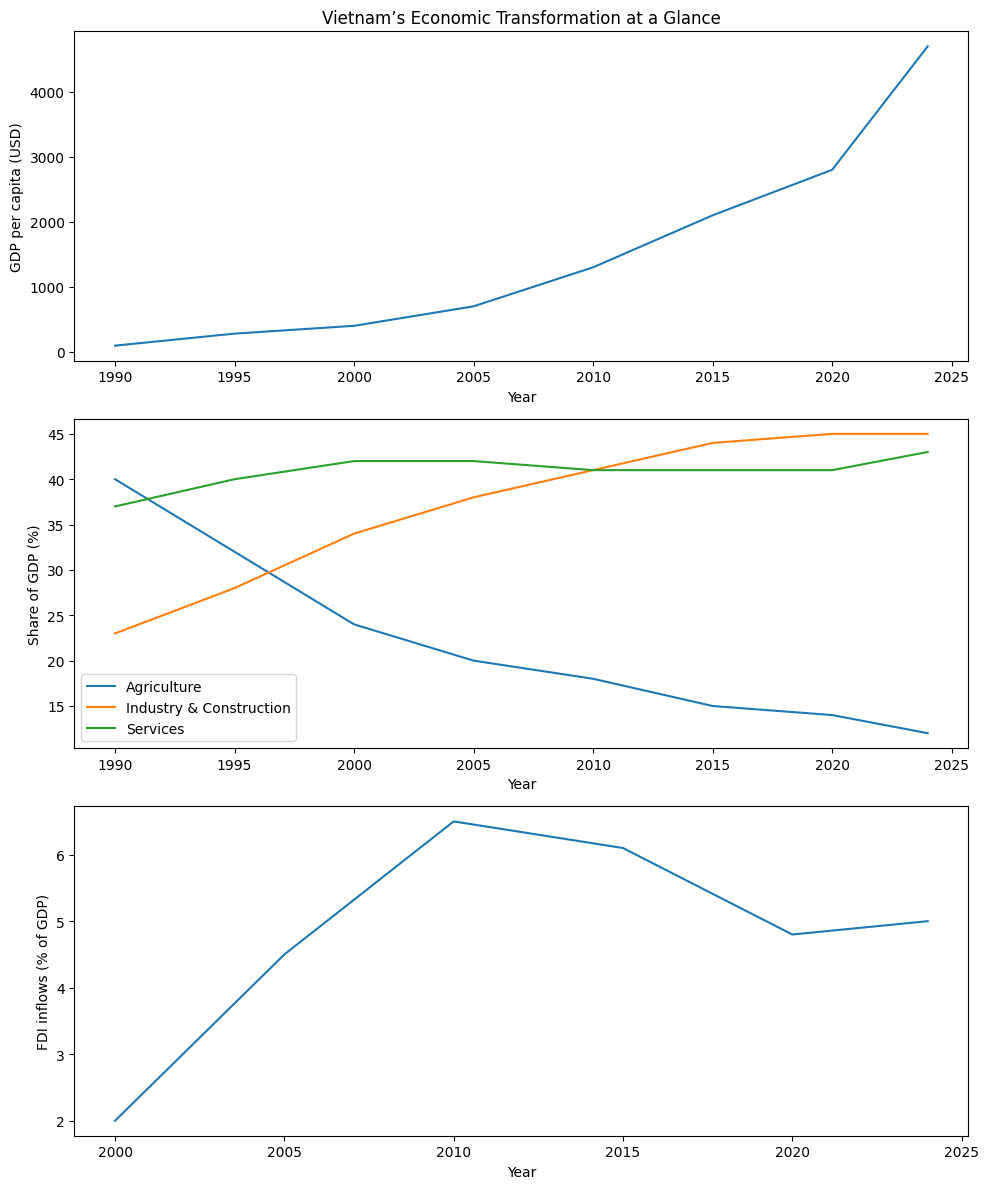
But what an amazing change it has been from 1999 to 2025! The Vietnam I just traveled through is barely recognizable. The numbers only confirm what one feels on the ground. In the late 90s, GDP per capita was in the low hundreds of dollars; today it’s around $4,700 in nominal terms and just over $14K in PPP - almost the threshold of a middle-income country. The structure of the economy, too, has flipped. In 1999, agriculture accounted for nearly a quarter of GDP; today it’s under 12%, overtaken by a robust growing manufacturing base (~38%) and a rapidly modernizing services sector (~42–50%) that takes advantage of the industrial base, in a typical Asian success story fashion. Those old software bootleg stalls have given way to high-tech industrial parks that are plugging into global supply chains to boost GVA in the country's industrial base. Clearly, a key catalyst has been the strategic decoupling of US–China trade — a shift Vietnam has seized with clear-eyed pragmatism. It also becomes clear that none of this was accidental. It’s the latest act in a long history of steady, focused resilience built into its national character. Vietnam has fought for its identity for millennia — resisting Han and Tang dynastic rule for over a thousand years, enduring French colonialism from the 19th century, and fighting the “American War” from the 1960s to 1975. Even after these wars concluded, border conflicts with China and the Khmer Rouge in Cambodia continued, before finally the country’s sovereignty could truly be secured. To see Vietnam today on this trip—confident, busy, and forward-looking—was, for me, extremely fulfilling; it was to witness the final victory of that resilient Vietnamese spirit.
Compared to the “Asian Tigers” neighbours, Vietnam’s rise stands out even more. Thailand and Malaysia industrialized much earlier, reaching upper-middle-income status while Vietnam was still rebuilding. But the gap is narrowing quickly. Whilst Thailand, unfortunately, has stumbled amid political instability and an overreliance on tourism and services ($7,300 GDP per capita), and Indonesia, despite its size, struggles with logistics and fragmentation ($4,800 GDP per capita) - Vietnam, has clocked compound growth on par with India, but with much stronger social foundations: 97%+ literacy and some of the highest female labor force participation rates in the region, better GINI ranking, and a much higer HDI. Vietnam may have arrived late, but I genuinely believe this economy has reached escape velocity!
As I leave the country to continue my SEA trip, I’m deeply grateful to all the colleagues who welcomed me, shared their stories, and introduced me to this “new” Vietnam. Their energy is truly contagious. In these conversations, I saw none of the post-war exhaustion that was still palpable in 1999. Instead, there was a hungry, outward-looking confidence. They have not only moved on from the past, now there is a clear, single-minded focus on a bright future.
Cảm ơn Việt Nam và tôi sẽ sớm quay lại. Thank you Vietnam, I will be back soon!
More in this area
New Zealand Needs a Government That Can Decide
The current election results have brought back all the reasons I have never been comfortable with MMP as the platform for New Zealand’s democracy. I think it brings back the arguments for a different architecture, not a minor…
Creating fiscal headspace by delivering outcomes and not just bills to taxpayers
I am watching the Conservative conference in Birmingham with some anticipation. The party chairman has promised more announcements about scrapping taxes before the week is out. Last week I wrote about Andy Burnham's first…
Youth, Tariffs, and India’s Strategic Autonomy Story
Two recent issues – the youth movement, new tariffs imposed ondemanded and Russian oil purchases and future tariffs of 100% on generics – made me reflect over the foreign policy posture of India. I have never been comfortable…