Hormuz, and the New Global Energy Order
The war revealed what we already knew, and chose to ignore: the global energy architecture was always one chokepoint away from structural failure.
The missiles were never aimed at Iran's enemies. They were aimed at us — our desalination plants, our LNG trains, our export terminals, our diversification projects. We knew the Iranian regime was a structural threat to everything the GCC was building. The war that broke out in February 2026 was not a surprise in its origin. It was a surprise in its immediate impact — for energy revenues, food supply, our water infrastructure, and the GCC's ability to move a barrel of oil through the only exit route they had spent decades building capacity around. The states were exposed. Not because they lacked capital or capability, but because six states with complementary assets, adjacent geographies, and aligned long-term interests had still not resolved the internal rivalries that kept them from acting as one.
The GCC now has a generational window. The blockade cleared the fog around what matters: bypass infrastructure, water security, food sovereignty, and trade corridors that do not run through a 33-mile chokepoint controlled by a hostile regime. The sovereign wealth to build it all already exists — $4 to 5 trillion today, $7.3 trillion by 2030. The complementary advantages are obvious: Saudi Arabia's scale and Red Sea access, UAE's logistics and financial infrastructure, Qatar's LNG expertise and capital, Oman's Arabian Sea coastline. No single state can build the architecture alone. Together, they can build something that no regional adversary and no distracted hegemon can hold hostage.
Some thoughts below on a direct argument for where that collective capital should go — because the opportunity is real, the window is narrow, and the cost of squandering it is now visible to everyone.
I. The supply shock is not going away
Twenty-one million barrels per day. That is what was moving through the Strait of Hormuz before the war — roughly a fifth of global oil consumption and a quarter of all seaborne crude trade.
The bypass infrastructure that Saudi Arabia and the UAE spent decades building has a combined effective capacity of under 9 million barrels per day. It was always the structural vulnerability. February exposed it.
The numbers from March and April are historic.
OPEC's output fell by 7.5 mb/d in March — the largest monthly decline in the cartel's history.
The EIA estimated Gulf shut-ins at 9.1 mb/d for April.
The IEA called it the most severe supply disruption in the history of global oil markets.
When you go country by country, the aggregate hides the asymmetry of pain.
Iraq. 3.9 mb/d, 100% Hormuz. The Kirkuk-Ceyhan line is unreliable and maxes under 1 mb/d on a good day.
Kuwait. 2.2 mb/d, 100% Hormuz, no bypass. Al-Ahmadi was hit on April 3.
Qatar. Roughly 19% of global LNG, all of it from Ras Laffan, all of it through Hormuz. 17% of capacity destroyed. $20 billion in annual revenue exposure. A three-to-five-year repair timeline. There is no LNG bypass — LNG does not travel through pipelines across oceans.
Saudi Arabia and the UAE. Partial exits only. Petroline is back at full capacity after the early-April Red Sea segment hit. Fujairah moves 1.5 mb/d against pre-war exports of 3.0 mb/d.
Oman. The lone outlier — Arabian Sea terminals, Hormuz-free, moving oil at near-normal volumes into a supply-starved market.
Total existing bypass: roughly 6.6 mb/d. Total stranded: 17–20 mb/d.
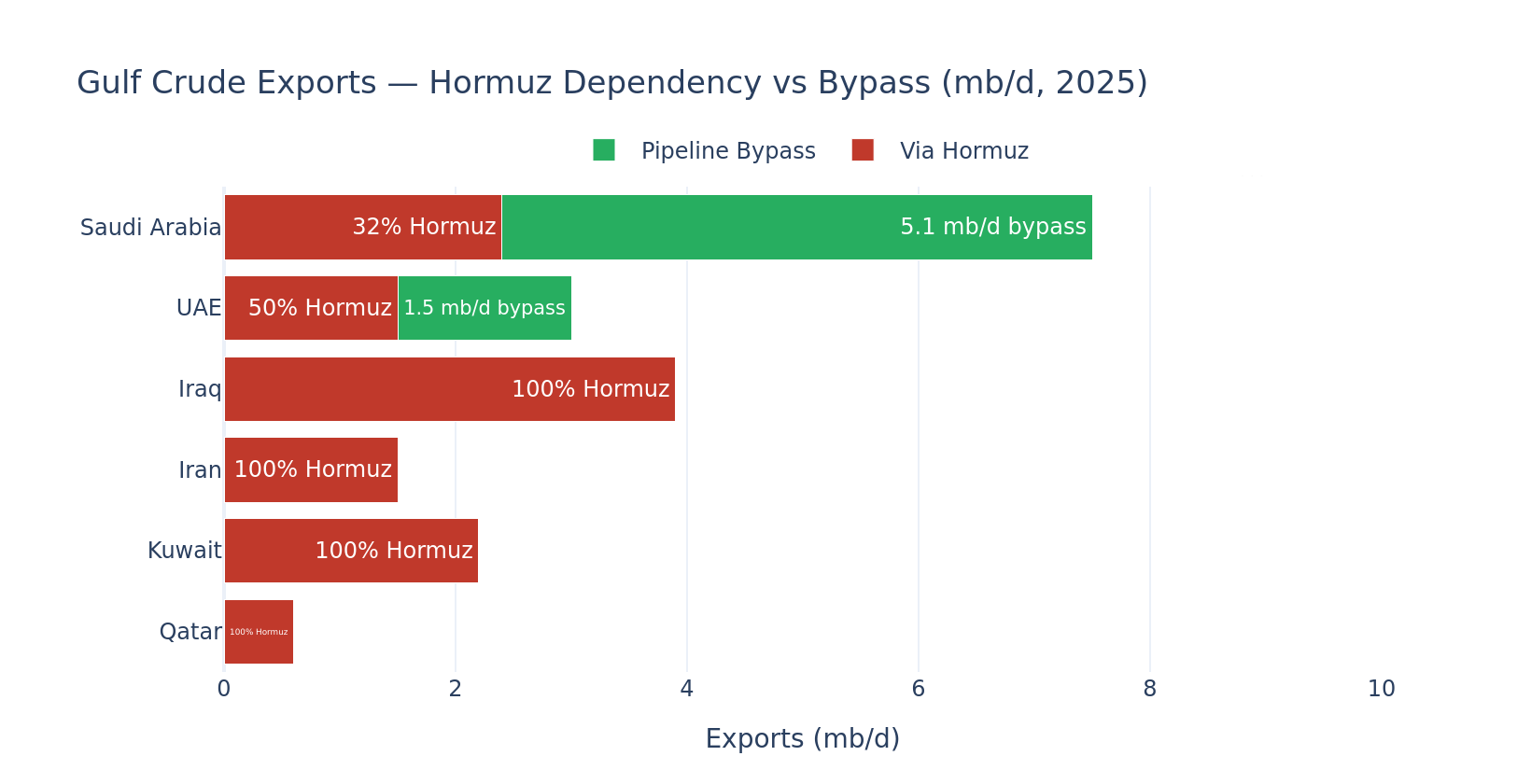
That deficit is structural, and it is persistent. Even if the ceasefire holds long enough to restart fields, recovery mirrors the outage — two months offline, two months back, assuming security is confirmed, insurance is repriced, and tanker operators agree to transit again. Qatar is a different category entirely. Not a restart. A rebuild. The first partial train cautiously came back in early April. Full capacity is a 2028–2030 event at the earliest.knew and
II. Stagflation is no longer an outlier
I believe this shock is landing on a monetary architecture that was already showing structural stress.
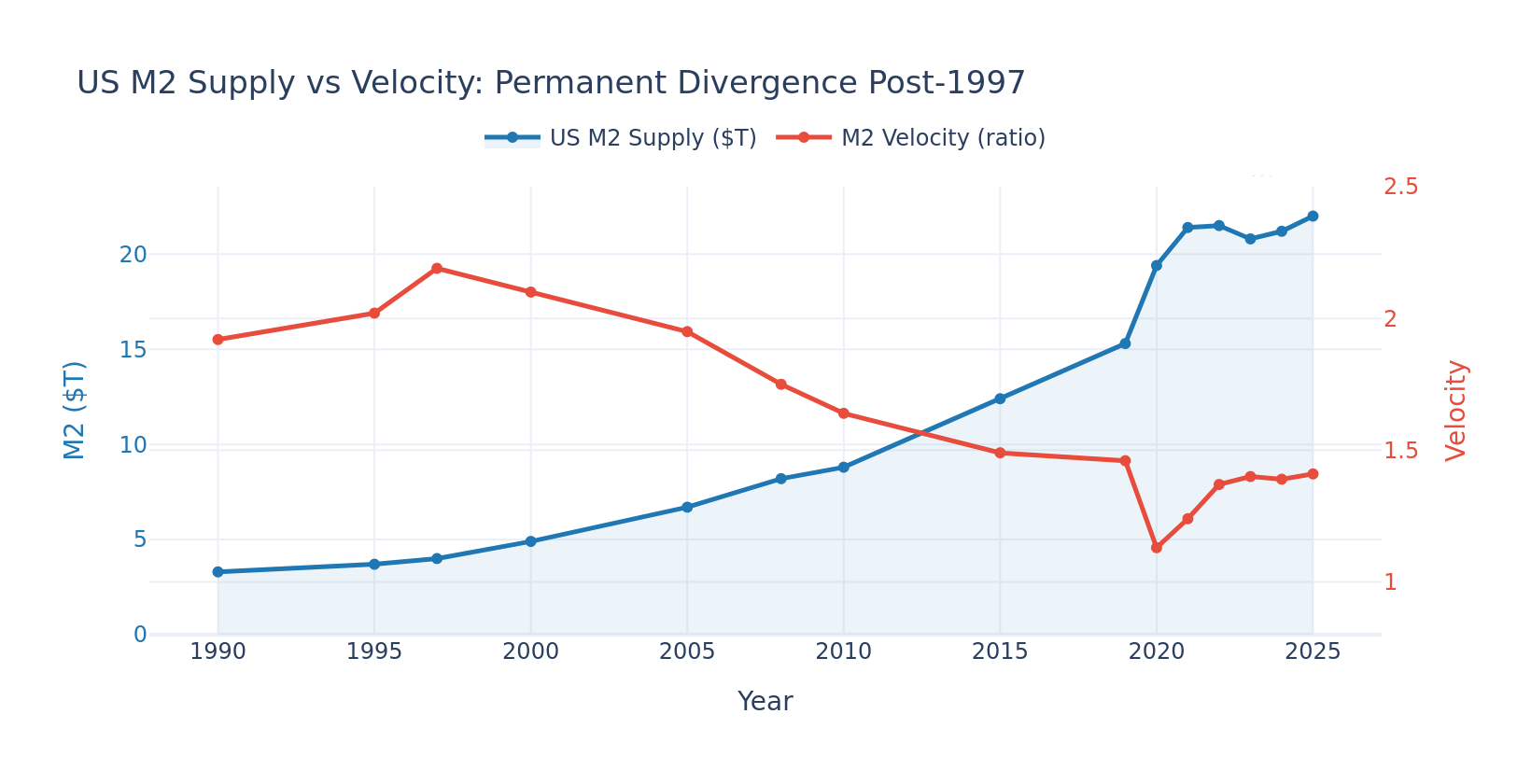
US M2 grew from $3.3 trillion in 1990 to $22.7 trillion in February 2026. The velocity of that money peaked at 2.19 in Q3 1997 and has been in structural decline ever since — 1.409 in Q4 2025, per FRED.
Three decades of liquidity creation, and the incremental dollar went overwhelmingly into assets. Not wages. Not productive capacity. Not consumption velocity. The Volcker fix worked on inflation. It never fixed the transmission channel from money creation to real-economy circulation.
The Phillips Curve broke after 2008. Tight labor markets stopped producing wage-price spirals because productivity gains accrued to capital, not labor. Wages grew. They never kept pace with productivity or asset appreciation. That mismatch is structural, not cyclical — and it means the policy tools available to central banks in a stagflationary environment are largely ineffective.
The OECD monetary system's ability to absorb a fresh 55% energy price shock is severely limited. This is not just CPI pressure. It is a regressive tax on every household and business that cannot pass through costs, hitting at the precise moment European and some Asian central banks were finally trying to normalise.
MUFG placed European adverse-scenario inflation above 5% for both the Eurozone and the UK.
Europe entered this with gas storage at 30% after a hard winter. Dutch TTF roughly doubled above €60/MWh.
Raising rates into a supply shock does not fix supply. It deepens the contraction while inflation persists.
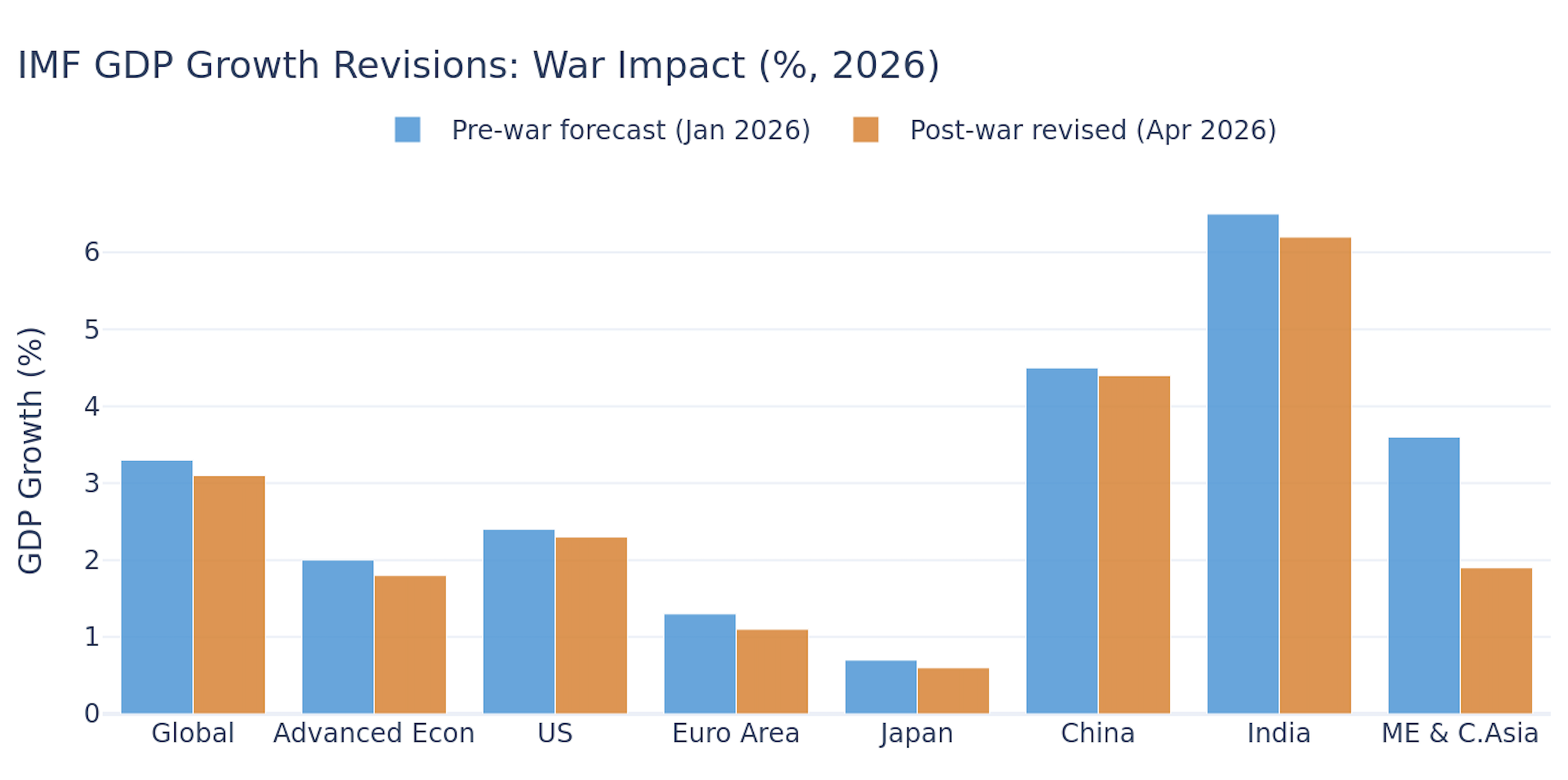
The IMF's April 2026 WEO quantified the damage.
Global growth: revised to 3.1% from a pre-war 3.4%.
Advanced economies: 1.8%.
Euro Area: 1.1%.
Middle East and Central Asia: down 1.7 percentage points — the sharpest regional cut in the world.
Adverse scenario: global growth at 2.5%.
Severe scenario: 2.0% — the IMF called it "a close call for a global recession."
The UNDP put GDP losses across Arab nations at $120–194 billion.
For China and India the transmission is different but equally blunt.
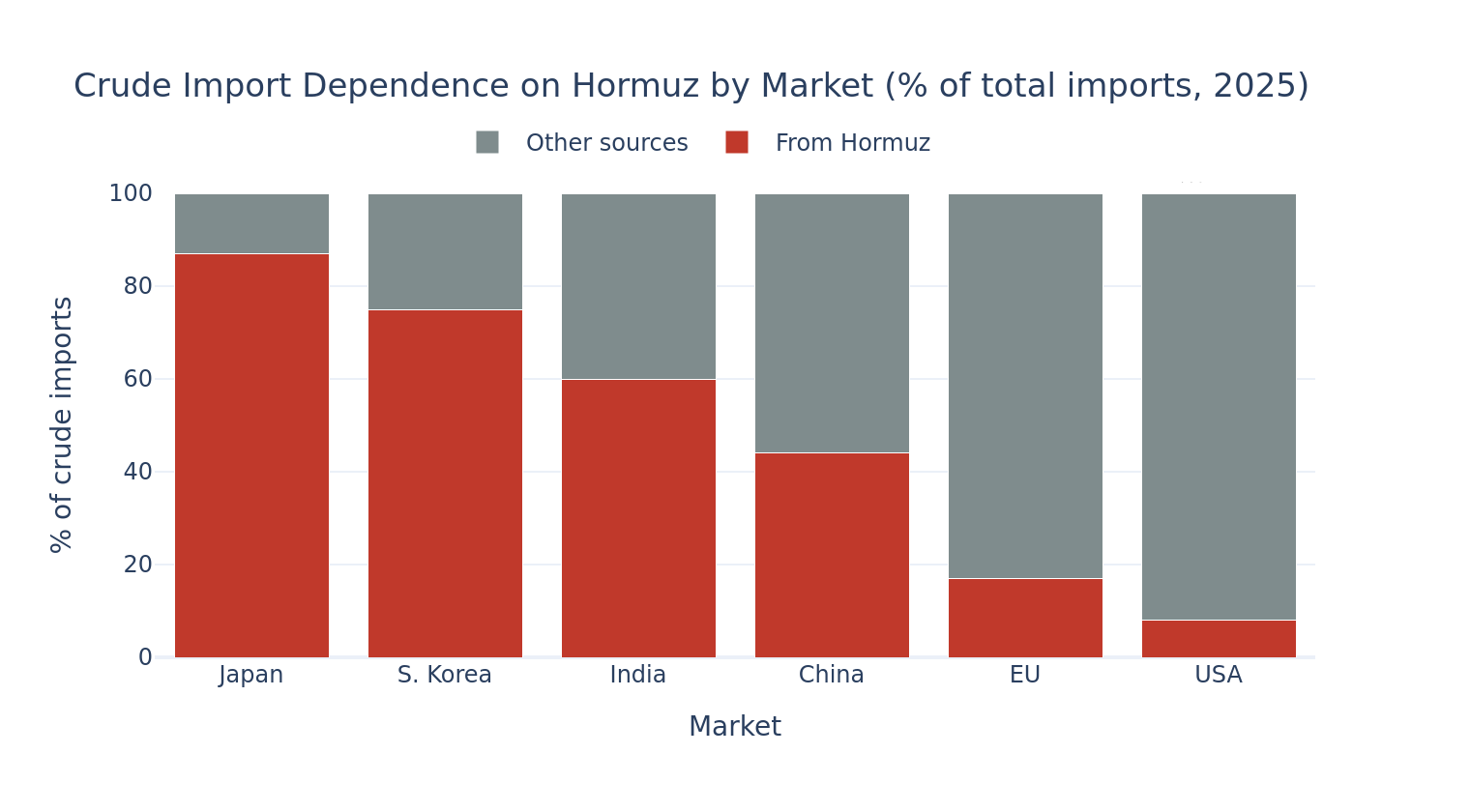
China was moving 4.45 mb/d through Hormuz before the war. By April that is 222,000 b/d — a 95% collapse in a single route.
India had just pushed Middle East crude dependency to 55% of total imports — the highest since 2022 — and saw Hormuz-transiting supply drop from 2.8 mb/d to 247,000 b/d.
Both are now competing for the same finite pool of Russian barrels, bidding up the differential for both. China and India together were projected to drive over 43% of global growth in 2026. Take a moment to digest that, and then look at equity markets continuing to print new highs.
III. Three endgames. None of them restore the pre-war order.
The damage to infrastructure, the rewiring of supply chains, and the permanent re-rating of Hormuz risk are embedded now, regardless of when the shooting stops. The question is purely who capitulates and when.
Scenario 1: Permanent Equilibrium Shift. A sequenced deal. Monitored Hormuz reopening and a halt to infrastructure attacks, traded for phased sanctions and blockade relief. Iran retains its political structure but accepts formal constraints. The GCC gets a security compact — non-interference, reparations, and a maritime framework. Brent drops $10–20 on a credible deal and settles in the $85–100 band. Stagflation moves from acute to slow burn. The catch: Iran's geographic leverage over Hormuz is preserved. The IRGC retains the capacity to reactivate coercion under any future political configuration. The GCC gets revenue recovery, but strategic security remains elusive without a substantial security build-out — leaving non-oil diversification at the mercy of Iran.
Scenario 2: Asymmetric Capitulation. Protracted blockade and sustained American pressure force Tehran into a lopsided agreement: comprehensive nuclear and missile constraints and guaranteed navigation and IRGC external-activity limits in exchange for economic relief. Hormuz reopens faster and more completely. Oil snaps toward $75–80 by the end of 2026. Fastest path to rate normalisation for OECD central banks. China and India can rebalance away from Russian dependence. Best case for global macro stability. The condition requires a prolonged decline in Iran's internal standing beyond existing levels — an eventuality that cannot occur without further escalation costs that the US lacks the political will to absorb and the EU has dismissed as beyond its capacity.
Scenario 3: Strait Trusteeship. The path of least resistance, and the most corrosive long-term outcome. Enough economic pain across all parties — OECD stagflation, Iranian collapse, GCC revenue implosion — to agree on multilateral trusteeship of Hormuz navigation without resolving the underlying conflict. The strait gradually reopens under international escort. A permanent $10–15 risk premium is embedded in global oil. Central banks are frozen — inflation above target but not spiking, growth below potential but not collapsing. Low-grade stagflation that persists for years without triggering a crisis acute enough to force resolution. For the GCC, this is the worst outcome dressed as stability — external control over their only export route and Iranian leverage legitimized rather than dismantled.
IV. The GCC has the capital - just lacks the will to use it collectively.
Nothing in those three scenarios changes the foundational condition: a 33-mile waterway controlled by a hostile state is the single point of failure for the world's largest hydrocarbon export bloc. The war made it expensive to ignore.
This is the right stimulus for GCC sovereign wealth funds to act decisively. The GCC collectively controls roughly $5 trillion in SWF assets today — ADIA at $1.11 trillion, PIF at $1.15 trillion, KIA crossing $1 trillion, QIA above $530 billion, with Mubadala and ADQ adding hundreds of billions more. Deloitte projects the pool reaches $8 trillion by 2030.
The capital exists. The structural energy security gap at home is not a funding problem. It is a prioritization problem, caused by an inter-state rivalry dynamic that has historically prevented coordinated capital deployment across borders for a collective cause.
Four places to point it.
1. Cross-border bypass infrastructure. UAE and Qatar co-invest in Saudi Red Sea export infrastructure — Petroline expansion, new Yanbu terminal capacity, a second Red Sea terminal near NEOM. Saudi Arabia gets capital and speed. Qatar and the UAE get access to a corridor they part-own. A UAE-Oman deep-water corridor — Hafeet Rail acceleration, a Duqm-Riyadh spine — creates a second Arabian Sea gateway immune to Hormuz.
2. Kuwait and Bahrain as corridor financiers. Neither has the geography to build bypass infrastructure. Both have limited capital deployment capacity. KIA and Mumtalakat can co-invest in the pipeline, terminal, and logistics assets being built by Saudi Arabia, the UAE, and Oman, in exchange for guaranteed export access through those corridors. Geographic liability converted into shared infrastructure stake.
3. Food and water security as productive investment. The blockade exposed two vulnerabilities in the same week. GCC states import roughly 80% of their caloric intake — retailers were airlifting staples within weeks of Hormuz closing. That is not a supply chain problem. It is a strategic dependency that SWF capital can directly address, through co-invested agricultural production capacity in East Africa, South Asia, and the Nile corridor — accessible via Red Sea and Arabian Sea routes, generating real productive returns while eliminating a vulnerability no amount of financial reserves can substitute for when shelves go empty.
Water is the harder problem. Bahrain's Ras Abu Jarjur, Kuwait's Doha West, UAE's Fujairah F1, and Qatar's Mesaieed complex all took hits or near-misses in March. Kuwait drinks 90% desalinated water, Qatar 99%, and Bahrain 85–90% — over 400 plants sitting fixed on Gulf coastlines, unhardened, within weapons range. Per US intelligence reports, a coordinated strike campaign could take out the majority of GCC drinking water in days.
The fix is dispersal, hardening, and redundancy: break up the mega-plant concentration at Ras Al-Khair, Jubail, Jebel Ali, and Az-Zour; build 90-day strategic water reserves against a current average of under 45 days; and fund cross-border emergency interconnects so one country's network failure does not become a regional humanitarian crisis. ADIA, QIA, PIF, and KIA co-investing in plants and pipelines outside their own borders converts this from a national infrastructure problem into a shared regional resilience platform – and produces a national security return no developed-market equity portfolio can replicate.
4. IMEC as the long game. The India-Middle East-Europe Economic Corridor is the only infrastructure program on the table that permanently reduces Hormuz dependency at strategic scale. The UAE is already the most advanced participant on the eastern leg. The EU-India trade deal signed in January 2026 — the "mother of all deals" — gave it political momentum it has lacked since 2023. GCC SWFs should anchor the financing of IMEC's energy spine — hydrogen pipeline, power interconnects, undersea data cable — because no other party at the table has more to gain from a diversified, resilient trade corridor. Saudi Arabia's willingness to include the northern section routes is the political key. The war has made that conversation easier, not harder.
The window
The obstacle to all of this is the same obstacle it has always been — inter-state competition for financial hubs, regional headquarters, and a preference for financial over strategic investment. The current shock exposes how superficial those rivalries look when the basic infrastructure of future prosperity is laid bare and fragile.
The cost of that rivalry is now quantifiable. Shut-in barrels. Destroyed LNG trains. GDP revisions. Populations paying 40–120% more for food staples in March. The shared threat assessment that was always theoretically available is now empirically confirmed.
The GCC has a narrow window in which the pain is still sharp enough to override the rivalry. What gets decided in that window determines whether the region exits this war with a permanently different strategic posture — or waits for the next crisis to have the same conversation, at greater cost.
I#GCC #EnergySecurity #Hormuz #SovereignWealth #Macroeconomics #IMEC #GulfEconomy #Geopolitics
More in this area
Iraq After the Hegemon
As I read today, 30 September, about the last American forces leaving Iraq, I can’t help but reflect on the past 23 years post-invasion – the mission 'not accomplished', and it all ends with a logistics convoy out of Kurdistan…
The Mecca Pact: Buying Deterrence, Selling Ambiguity
The Kingdom, Turkey and Pakistan just signed a mutual defence pact in the middle of a live war in the region — and all three are allies of the same power whose retreat made the pact necessary. That, to me, is the key sentence…
Middle East: After the Islamabad Memorandum
I landed back in the Gulf, where the war has technically ended. The malls are full, coffee queues are long, and the only real signal of stress is on shipping maps and in bond spreads, not on the shop floor. The region is open and…