Structural Exhaustion of the Consumer and the Global Macroeconomic Paradox
Over the last 4 decades, monetary and fiscal stimulus have ceased to be an emergency measure, more of a seasonal exercise - mostly with central banks and lawmakers egged on to maintain "economic growth", by the money markets. Empirical evidence clearly suggests that the effectiveness of these measures has faded as these perennial cycles of policy recalibrations continue to ignore a fundamental structural breakdown that no amount of liquidity injection or fiscal stimulus can repair - the wages-productivity divergence. This divergence is finally leading to the consumer, capitalism's ultimate engine, approaching structural exhaustion.
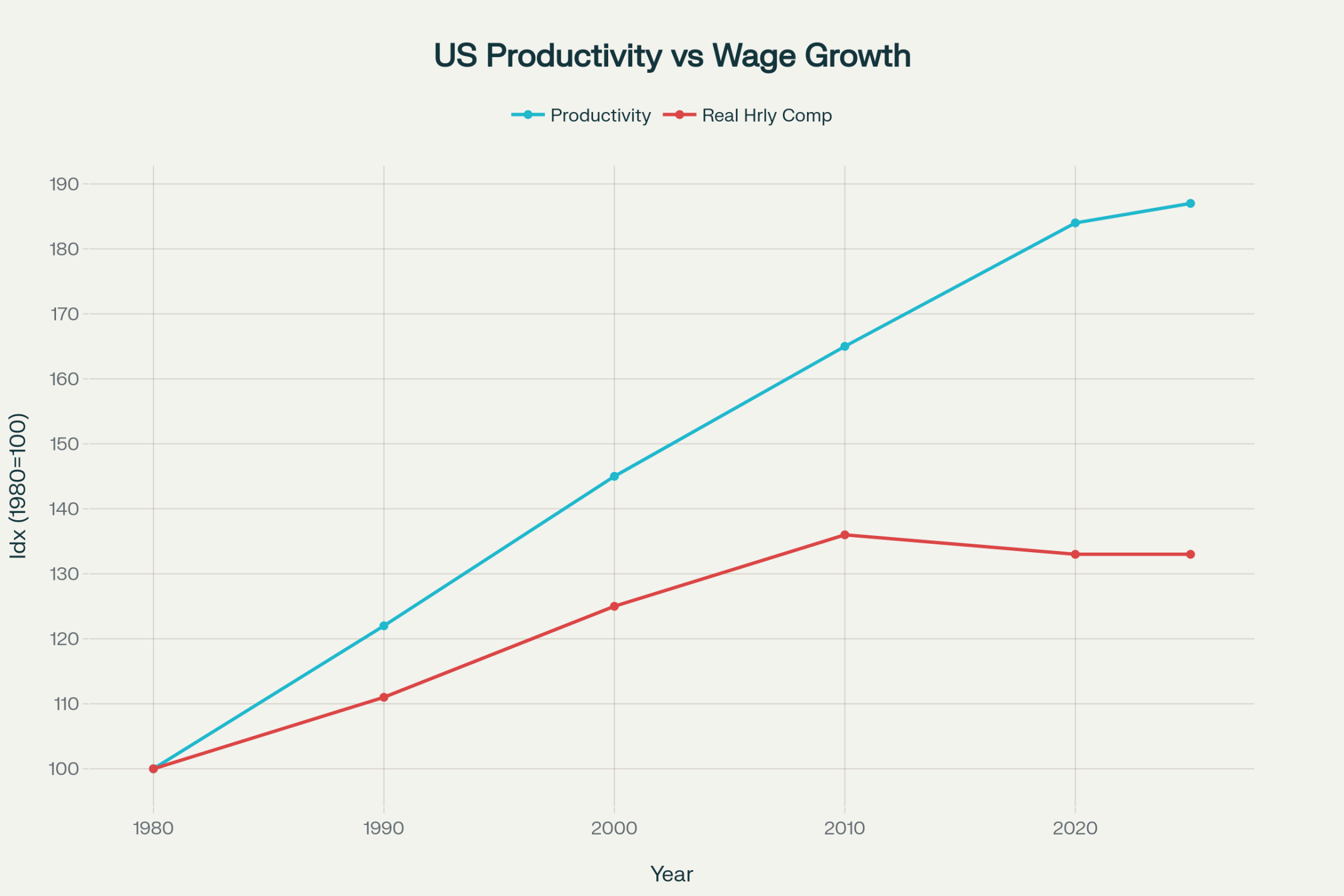
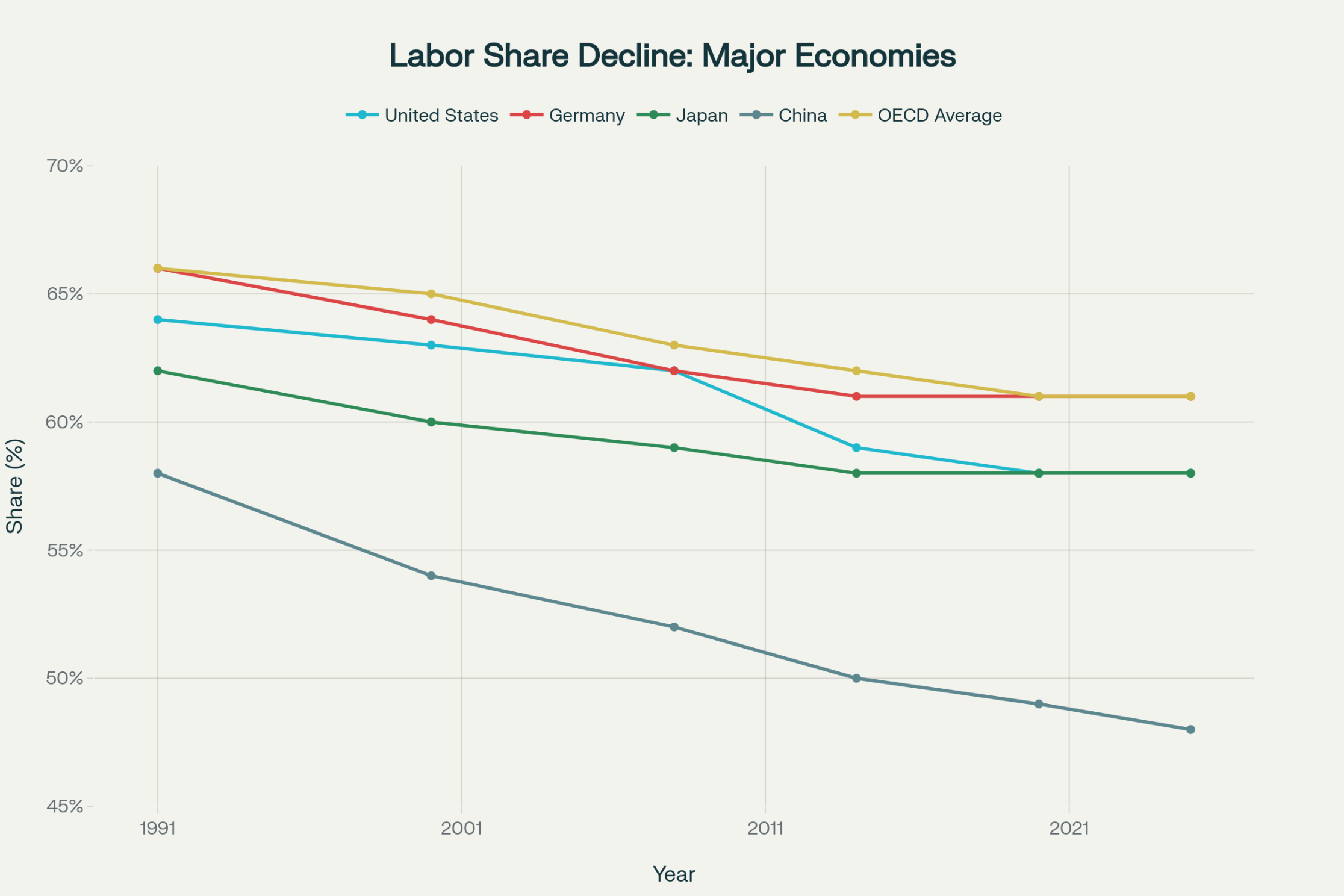
Since 1980, labour's share of national income has been declining systematically across major economies - labour's share of GDP across OECD member countries fell from 66% to 61% between 1991 and 2025. The drop in the United States and China was even more pronounced, from 64% to 58% and 58% to 48%, respectively. Even as US productivity increased 87% between 1979 and 2025, real hourly compensation rose only 33%—productivity grew nearly three times faster than pay. The UK's experience is even more dramatic: real wage growth averaged 2.7% annually from 1980 to 2007 but collapsed to 0.1% from 2008 to 2023, dropping from 3rd to 16th among OECD nations.
Automation and ICT capital, as one can well imagine, are the primary drivers of the decline in labour share, further accentuating wage polarisation between white- and blue-collar workers. Whilst low- and middle-skilled workers lost more than 7 percentage points of income share globally between 1995 and 2009, high-skilled labour gained 5 percentage points. Most economists attribute approximately two-thirds of the US labour share decline between 2000 and 2016 to increasing market power, enabled by technology-driven consolidation. This is a fundamental reordering of production factors: capital claiming expanding shares of output while labour's bargaining power erodes structurally, disconnecting compensation from productive contribution.
The Federal Reserve's balance sheet has exploded from $0.9 trillion in 2007 to $8.9 trillion by 2022—a tenfold expansion purchasing over $5.6 trillion in Treasuries and mortgage-backed securities, which, as former Fed Chairman Alan Greenspan opined in 2012 that QE had "very little impact on the economy" despite massive balance sheet expansion. All it achieved was pushing investors from government bonds into equities and corporate debt, inflating asset prices and money markets while bypassing wage earners. The Bank of England explicitly acknowledges that QE increases financial asset prices, making asset holders wealthier—a wealth effect concentrated among top-income earners who hold most financial assets.
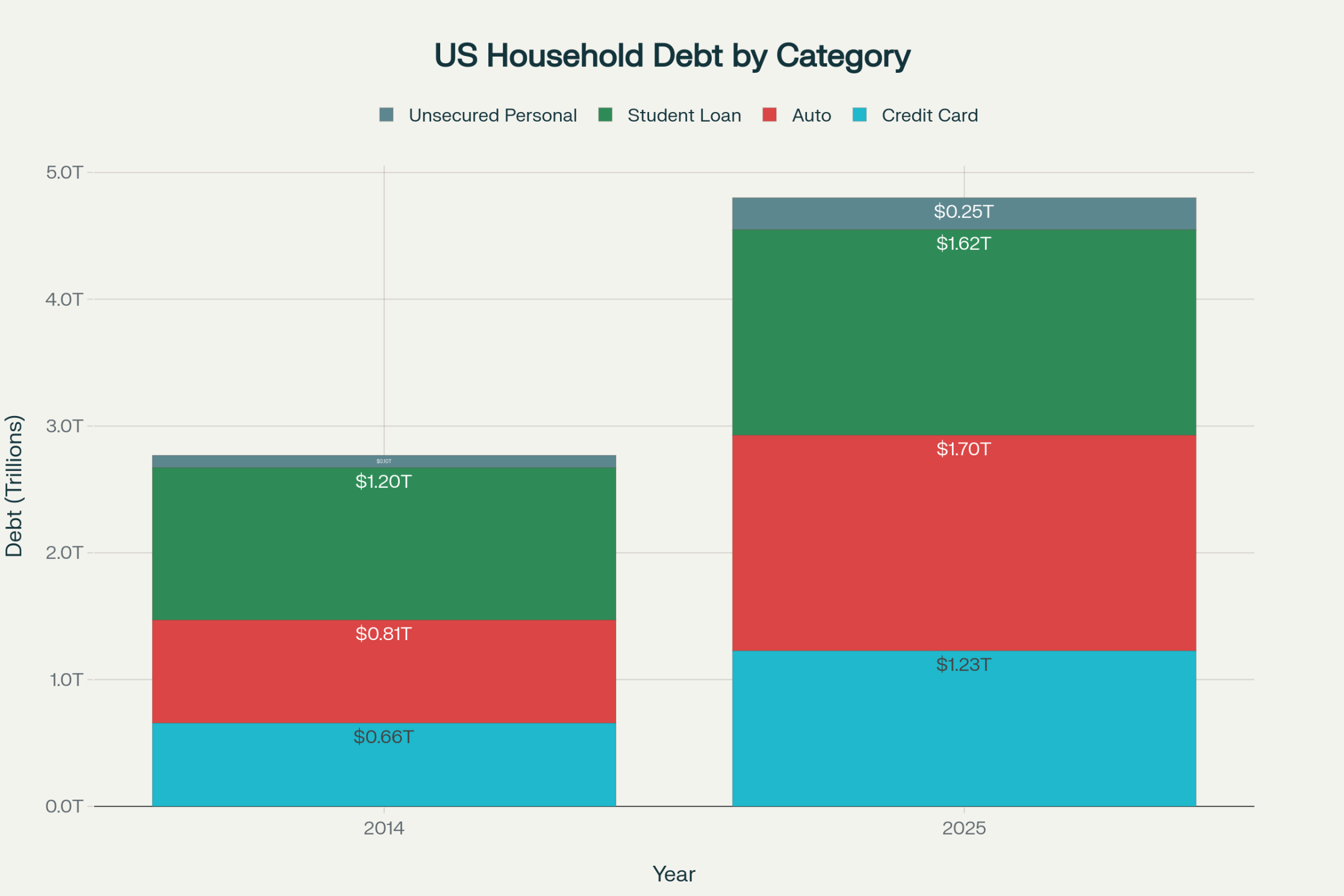
Faced with stagnant wages and rising asset prices, households have exhausted savings and are increasingly turning to credit on an unprecedented scale. US credit card debt has surged from $0.66 trillion in Q1 2014 to $1.23 trillion in Q3 2025—an 86% increase—and delinquency rates have reached 3.05%. In addition, the Buy Now Pay Later (BNPL) market has exploded from $231.5 billion in 2024 to a projected $1.43 trillion by 2029—a 44% CAGR!
The increasingly heavy debt burden on households, specifically the blue-collar segment, is revealed by Consumer Financial Protection Bureau data - 63% of BNPL borrowers originated multiple simultaneous loans in 2022, and 45% of these borrowers have deep subprime credit scores, maintaining credit card utilisation rates between 60-66% simultaneously. Unsecured personal loans, too, reached $253 billion, with 29.8 million loans in Q1 2025, and are projected to grow at a 15.65% CAGR through 2031. What worries me is that the mechanism that used to be discretionary credit for large purchases has become the basis for daily expenses—groceries, utilities, rent.
Beneficiaries of labour arbitrage and the displacement of blue-collar work, the emerging-market consumers, too, can't sustain global demand. Chinese policymakers are struggling to stimulate domestic demand, with retail sales growth decelerating to 2.9% year-over-year in October 2025—the fifth consecutive month of slowdown and the longest streak since 2021. India's GDP growth has slowed down to 4.7% for fiscal 2025—a four-year low—with private consumption diverging sharply from headline GDP since March 2023. Fast-moving consumer goods sales are stagnating, with discretionary categories shrinking. Stagnant or even shrinking real incomes are increasingly leaving the middle class unable to support incremental spending.
Consumers across developed and developing economies can no longer sustain spending through debt accumulation. Without fundamental reforms reconnecting wages to productivity—a recalibrated social compact where labor shares meaningfully in output gains enabled by technology and capital—the global economy faces prolonged stagnation as the consumption engine approaches structural failure. This challenge and imperative become even more urgent as we expect Artificial Intelligence and Robotics to further compress labour's contribution to GDP.
For policymakers and institutional investors: the structural challenge is no longer cyclical demand management but systemic redesign of how productivity gains should be distributed across factor inputs.
#MacroeconomicRisk #StructuralReform #LaborProductivity #ConsumerDebt #GlobalEconomy #PolicyAnalysis
More in this area
Midterms and AI expenditure
A few people have asked me whether the midterms put the brakes on the AI buildout. I went back through the data, and my view is that 'Bluenami' :-) will change the pace and the cost of the AI buildout. They will not change its…
Debt, Inflation, and the Narrowing Room for Policy—The Rising Cost of Running the State
I listened to Andy Burnham’s first Labour conference speech as Prime Minister, as he set out a larger role for the British state: a national care service, more council housing, changes to pensions and greater public involvement…
When the Money Goes Nowhere — and Everywhere at Once
Today, I heard the phrase used by Sunaina Sinha , who described the current state of IPOs and the flood of capital into equity markets as the "Party of Capital". This resonated deeply with me. I may sound like a broken record to…